Thursday, 3 October 2013

The hidden costs of welfare reform

Both the left and right in British politics are obsessed with economic outcomes.  The impact of a policy – whether it is a tax cut, tax rise, welfare reform or a free school meal – is almost exclusively evaluated and argued over in terms of its economic effect.  Will it make people better off? Who are the winners and losers?
We often seem to forget that policies have other effects too.  Extending free school meals, for example, will not just give parents more income, but more time.  In schools, it might give a stronger sense of togetherness amongst pupils (less us versus them).  For policy-makers, it will make it easier to improve children’s nutrition.
The same is true of welfare reform.  The research that more or often than not makes the headlines is that which prices up the impact of a new policy.  The IFS are masters at this.  A policy is judged as a success if it happens to put an extra fiver in someone’s wallet.
Yet we cannot understand the true impact of a policy without considering a broader range of outcomes.  And this is the case most poignantly in the area of welfare, where the most disadvantaged and vulnerable people in society have been subjected the most powerful policy changes.  Welfare reforms have made many people poorer, that’s true.  But the wider costs go way beyond tightened purse strings.
We got a sense of these costs this week, with new research in the BMJ showing a rise in suicide associated with the global recession.  My own research focuses on the health and well-being impact of unemployment and the ways in which welfare reforms alter the nature of experienced worklessness.
My findings are somewhat complex to untangle.  In some instances, moving people to welfare-to-work schemes appears to improve well-being.  But there are many caveats here: this only appears to hold for younger people and for people on specific types of programmes.  Unsurprisingly, there is no well-being benefit to the Work Programme.
However, there is one solid finding I encounter time and time again: people who are put on welfare-to-work schemes have significantly higher anxiety than other unemployed people.  The graph below (using data from the Annual Population Survey) shows that unemployed people have an anxiety score of 6.42 (the higher the score, the lower anxiety).  This, as we would expect, is lower than those in work, students or the retired.  However, people on welfare-to-work schemes have much higher anxiety than the unemployed (6.25).
AnxietyDS
Further, this relationship holds even when we look at different types of welfare-to-work participants.  The evidence shows that the kind of welfare-to-work participant who benefits most from these schemes tend to be young, male, poorly educated and enrolled on a scheme that gives demonstrable training or work experience, as opposed to the Work Programme.  However, even these types of participants have similar levels of anxiety to the unemployed.
This evidence leads to a worrying conclusion – welfare-to-work (and potentially welfare reform in general) – leads to an increase in anxiety amongst the unemployed.  Why this might be is an avenue for future research.  The evidence on welfare-to-work is mixed – for certain types of people, and for certain types of wellbeing, some kinds of welfare-to-work programmes appear to be positive.
However, for most participants – regardless of age, qualification level and gender – welfare-to-work appears to increase anxiety.  This is a potent reminder that the costs of welfare reform cannot – and should not – be measured in economic terms.  They go way beyond what can be counted in pounds sterling.

Where to go next with welfare reform?

Over 18 months ago I wrote a post about 'welfare reform 2.0'.  It argued that the Coalition would not stop with present reforms, driven by the belief that social security must be radically changed and (most importantly) that the public want to see this.

Then, I made five predictions about where the Coalition would go next.  These were:

  • Intensified workfare
  • Time-limited benefits
  • Abolishing contributions-based benefits
  • Regionalised benefits
  • Limiting Child Benefit
Since I published that piece, only 1.5 of my predictions have come true.  The Government will intensify workfare (announced this week but piloted for the past year) and they have limited Child Benefit, but only to richer families.  They haven't, yet, limited the amount of children that Child Benefit is payable to.

There are numerous reasons why new reforms have been relatively scarce during the past year and a half.  One reason is that the Government has been preoccupied by the introduction of Universal Credit and its other reforms, such as the benefit cap.  There simply hasn't been the time to focus on new reforms.

Secondly, the politics of the Coalition prevents the introduction of even more punitive welfare reforms.  The Lib Dems like to boast that they have tamed the Tories from their wilder instincts.  As the Coalition has already gone pretty far, new reforms will be within an exclusively Conservative sphere.

The third is more strategic.  The Conservatives are already way ahead on welfare; there isn't, as yet, the political incentive for them to go too much further.  This means that as the election in 2015 approaches, we'll probably see more and more policy proposals on welfare.

Finanlly, I could just be bad at making predictions.  We'll see.  But the big announcement yesterday - that benefits may be stopped for young people - suggests that, far from it, the Tories aren't finished yet.

Thursday, 12 September 2013

Does welfare-to-work boost well-being?

As ‘gizza job’ became one of the iconic catchphrases of the 1980s, the character synonymous with it – Yosser Hughes from Alan Bleasdale’s Boys from the Blackstuff – became one of the most devastating fictional representations of the psychological harm caused by unemployment. Made redundant, Yosser’s life soon disintegrates: he loses his savings, his children are taken into care and he becomes homeless. Driven to desperation, Yosser tries to commit suicide by walking into a lake. Bleasdale’s message was clear and is, simultaneously, one of the most robust findings in social science research: unemployment hurts the mind.
The evidence on worklessness leads to the argument that governments should try to protect people against the harmful mental health effects of unemployment. For the Right though, it is questionable whether we even should try to do this. Shouldn’t unemployment be difficult, the argument goes, so there is an incentive to find work? For the Left, typical solutions revolve around full employment schemes and higher benefits. But both of these positions are on shaky ground. Against the conservative stance, it far more likely that happier people will be more motivated to find a job than those driven to despair. The traditional centre-left response meanwhile would require significant increases in public expenditure; whilst this is not impossible it is, for the moment, politically untenable.
My research focuses on the potential that welfare-to-work programmes have for improving well-being outcomes for unemployed people. It is based on the idea that participating on a welfare-to-work scheme brings about a change in environment and status that is potentially, compared to ‘open unemployment’, more psychologically favourable.
The evidence from other countries is tentatively positive. Research from GermanySweden and the United States has shown that jobs programmes are apparently associated with improvements in subjective well-being. And the evidence from the UK appears to show the same. In analysing two large British social surveys – the cross-sectional Annual Population Survey and the longitudinal British Household Panel Survey – I find the results from both surveys are the same: compared to unemployed people, participants on welfare-to-work schemes have significantly higher well-being. The effect is not large (it isn’t comparable, for example, to the effect of actually being in paid work) but it does seem real.
So, does this mean we should start supporting big welfare-to-work schemes, like the Government’s Work Programme, as a means to improving the well-being of the unemployed? Whilst the straightforward answer seems to be ‘yes’, there are some important caveats to be found in the data.
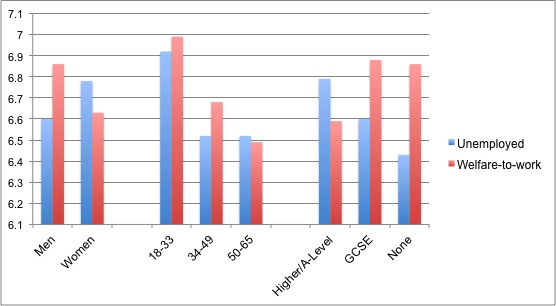
The first is that welfare-to-work schemes appear to improve well-being, but only for certain types of participants. Take a look at figure 1 below, which shows the average happiness scores (ranging from 0 to 10) of unemployed people and welfare-to-work participants. The scores are broken down for three key socio-demographic variables: gender, age and highest qualification level.
The scores demonstrate that welfare-to-work appears to make some people happier compared to unemployment, but not others. For example, male welfare-to-work participants are much happier than other unemployed men; but the same cannot be said for women, where the relationship works the other way around. In addition, people on welfare-to-work schemes who are aged up to 49 appear happier than the unemployed, but this is not true for older participants (aged 50-65). Finally, the most explicit differences are found when we split the scores by highest qualification. For those who are highly educated (up to degree or A-Level), unemployment appears a brighter prospect than welfare-to-work. However, for those with lower levels of qualifications – especially those with none – there are apparently large gains to be had from active labour market programmes.
Figure 1: Average happiness levels for unemployed people and welfare-to-work participants, split by demographic characteristics
Sage fig 1
Note: Graph is based on data from the Annual Population Survey.
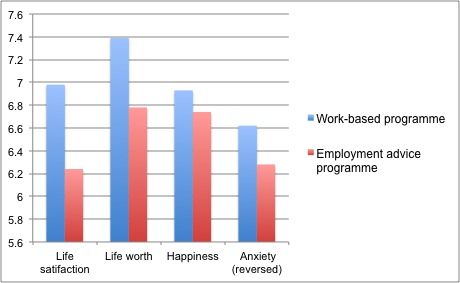
So this is the first caveat: welfare-to-work only improves well-being for certain people. The second is that not all welfare-to-work programmes have positive effects. Broadly, we can split these programmes into two types: those that involve intensified employment advice (like the Work Programme and, before it, the New Deal) and those that involve training or work experience (more work-based schemes). The graph below shows the mean scores for four indicators of well-being by the type of welfare-to-work scheme that people are on. Again, there is a clear trend. People on programmes that involve acquiring skills, qualifications or work experience have much higher well-being than those who are simply receiving more employment support. Indeed, being on the latter type of scheme is relatively similar to – and sometimes worse than– open unemployment.
Figure 2: Average well-being scores, split by type of welfare-to-work scheme
Sage fig 2
Note: Graph is based on data from the Annual Population Survey.
We don’t know why welfare-to-work has this variable effect, but it’s possible to pose some ideas. Many women have to balance job-seeking activity with caring responsibilities; requiring such women to participate in back-to-work schemes may only intensify these pressures. Older people with a lifetime of paid work may find the reality of unpaid work experience more humiliating than those with little to no labour market history. Those with low qualifications may have different expectations of work than those with a degree. Gaining skills, feeling valued and working directly with employers is a lot different to seeing an adviser once a week and being told how to write a better CV or dress for an interview.
The government is increasingly keen on thinking about how public policies can improve well-being. In this sense, unemployment should be a high priority area: it is one of the life events that is most damaging to happiness. Research shows that welfare-to-work programmes can improve well-being for those out of work, but we must be careful. The evidence suggests that in order to achieve well-being gains, such schemes must be appropriately targeted, personalised and worthwhile. Improving well-being through welfare-to-work is not straightforward. To make stronger and more widespread gains, it is likely that the government will have to try a much different approach.

Wednesday, 11 September 2013

Is the left really in meltdown across Europe?

There has been a lot of talk amongst political commentators this week about whether or not Europe (and the developed world more broadly) is seeing a lurch towards the right and a lurch away from the left.  This has been sparked by two election victories in which conservative parties ousted social democratic ones from power (Australia and Norway).  In the FT, Janan Ganesh says this is part of a wider context in which the left ‘called the crisis’ wrong in the eyes of voters.  Today, Toby Young tweeted that 'the left is in meltdown all over Europe’. 

But how true is this?  Are voters really turning away from the left, en masse?

Division of power in the EU

Centre-left
Centre-right
Austria
Czech Republic
Belgium
Estonia
Bulgaria
Finland
Croatia
Germany
Cyprus
Greece
Denmark
Hungary
France
Ireland
Italy
Latvia
Lithuania
Luxembourg
Malta
Netherlands
Slovakia
Poland

Portugal

Romania

Slovenia

Spain

Sweden

UK

All in all, the centre-right has power (either governing alone or as the largest party in a coalition) in six more EU countries than the centre-left.  So there is undoubtedly a momentum with conservatives, although not as much momentum as celebratory journos might have you believe.  Further, in places like Ireland and the Netherlands relatively strong social democratic parties share power with the right.  And by 2015, it is likely that the left will regain power in Sweden and the UK.

So why is there a general air of defeatism amongst the left in Europe?  And triumphalism amongst the right?  One reason is surely the nature of where the centre-right has been successful.  In all the countries where the crisis hit hardest (Portugal, Spain, Ireland, Greece) voters have put their faith in conservatives.  In Germany and Sweden, there has been an unparalleled dominance of the centre-right in countries with important social democratic traditions.


So the left needn’t been too downhearted: it is still in power across much of Europe.  Of course, the facts on who is in power tell us only so much about the policies they are implementing and the grounds on which elections have been won.  If the left is in power and largely implementing centre-right economic policies as a response to the crisis – as Francois Hollande has been accused of - the conservative commentariat might, after all, have a valid point. 

Thursday, 15 August 2013

Do people really 'get used to a life on benefits'?

The cornerstone of the Coalitions' welfare reform agenda is the idea of 'welfare dependency'.  That people, as they remain reliant on the social security system, acclimatise to being unemployed: they no longer want to work, they adapt to a life without work and they get used to a life on benefits.

If people get used to a life on benefits, then the rationale follows that they need stronger incentives to move into work.  This logic is the justification for most of the Coalition's welfare reforms: the Universal Credit, the benefit cap, stronger sanctioning and welfare-to-work programmes.


But how valid this is this assumption?  Do people get used to a life on benefits?

One way to find out is by tracking individuals who remain unemployed over a prolonged period of time.  If people get used to benefits, then we would expect these individuals - the longer unemployment goes on - to become happier and more content.  In the subjective well-being literature, this phenomenon is called adaptation.  

In short, when people suffer a shock to their normal life (divorce, widowhood, childbirth), they tend to experience a quick change in their life satisfaction.  But over time, their life satisfaction 'resets' itself to its pre-shock level.  People adapt to their new life circumstance.  This is essentially the argument of the Coalition in relation to the unemployed.  After so long, people adapt to unemployment: it becomes their normal way of life.

Data from the BHPS however suggest this is not the case.  In the course of some other work I'm doing on the long-term effects of welfare-to-work programmes, I took a look at the effects of long-term unemployment on well-being.  The main question I wanted to check was whether people do adapt to unemployment the longer it goes on.  To do this, I split unemployed people into five groups: those who had been unemployed for 1 year, for 2 years and so on, up to 5 years of continuous unemployment.

If people adapt to unemployment - or 'get used to a life on benefits' - we would expect the long-term unemployed to have significantly higher subjective well-being than those who have recently experienced the 'shock' of becoming unemployed.  But this is not the case.  Once we control for a whole range of background factors, we find that there is no significant difference between the long-term unemployed and the recently unemployed.  They are, to put it crudely, as miserable as each other.

Unemployment then is not a condition that people ever get used to.  Whilst people tend to adapt to other life events - even widowhood - they do not get used to permanent exclusion from the labour market. This gives us an idea of the true extent of the social and psychological damage inflicted by unemployment.  And should give politicians food for thought in the way they talk about its victims.


The long-term effects of unemployment on well-being


Wednesday, 31 July 2013

Welfare-to-work, in perspective

The image above illustrates the large network of what policy academics call ‘active labour market policies’ (ALMPs); or what politicians refer to, in the increasingly Americanised language of social security, ‘welfare-to-work’.
ALMPs are big business.  They are in large part carried out by huge private sector providers, such as A4E and G4S, as well as a ‘supply chain’ that consists of hundreds, if not thousands, of smaller organisations and companies. According to the BBC, the Work Programme alone is expected to cost up to £5bn.
But as well as being big business, ALMPs are an integral component of the social security ‘contract’ that exists between the state, the public and benefit claimants.  The contract, so it goes, is that unemployed people agree to a wide range of – often stringent – work-related conditions: this in return for (a) benefits and (b) the provision of back-to-work ALMPs.
The state then, like the unemployed, has rights and responsibilities: the right to expect benefit claimants to take certain steps to get back into the labour market, but also the responsibility to provide good services that enable a transition back to work.  So this raises an important question: how well do we actually provide for the unemployed in terms of labour market programmes?
A simple but effective way to answer this is to look at what other countries do.  The OECD is a useful resource here, as they collect statistics on how much countries spend on ALMPs.  The graph below shows how much other European countries spent in the most recent year of data collection, as a percentage of GDP.
Spending on ALMPs in the OECD (% GDP)

As is obvious, we don’t do very well: spending on ALMPs is just 0.38% of our national income.  In fact, the only countries that spend less than us on ALMPs are the former communist states of Slovakia, the Czech Republic and Estonia.  What’s far more normal for countries like us, in terms of GDP, is for over 1 per cent on all spending to go on welfare-to-work, such as in the Netherlands (1.2%), France (1.1%) and Belgium (1.5%).  Denmark, meanwhile, spends a whopping five timesmore than the UK does on back-to-work schemes.
Our poor record on ALMPs is reflected even more intensely in what the EU calls ‘the activation rate’.  This is the number of unemployed people, per 100, who are enrolled onto welfare-to-work programmes.  The image below shows the pitiful coverage of UK provision: for every hundred unemployed people, just over one person is participating in activating schemes.  This compares to rates of over a fifth in other major West European economies, such as Italy, Sweden, Spain and Belgium.
The ‘activation rate’ in EU countries
In fact, the UK is bottom of this league table across the entire EU.  This means there are a higher proportion of unemployed people on ALMPs in countries like Bulgaria, Romania and Lithuania.  Even tiny Malta has a higher activation rate than the UK.
So, whilst the state asks a lot from the unemployed, it simultaneously fails to provide them with a relatively high standard of labour market programmes.  The key point here is not that it’s unfair to ask – or even compel – unemployed people to take steps back to work.  Rather, it’s unfair that we ask so much of the unemployed yet do so little, compared to other countries, to help them.
David Cameron and George Osborne like to talk about the ‘Global Race’ that the UK is in: a race where we must compete more effectively and efficiently against our economic competitors.  Yet if we really are in a ‘Global Race’, then surely a test of how where we stand is by how much our government invests in reskilling the unemployed.  And on this test, we are miserably failing.
This article originally appeared on the site RealFare

Wednesday, 5 June 2013

Have universal benefits had their day?

This week, Labour has made some (potentially) significant shifts in its welfare policy.  On Monday, Ed Balls announced that a future Labour government would seek to means-test the universal Winter Fuel Allowance.  And today, the BBC report that Ed Miliband will state that Labour wouldn't reinstate the universal principle to Child Benefit.  These are significant shifts: suggesting that Labour is coming into line with centre-right (and perhaps public) views on universality.

The Right have never liked universal benefits: seeing them as a waste of money and unaligned with the proper purpose of social security, which is need.  The Left have never really been able to argue against this point: many people receive benefits who don't, in the strict sense of the word, need them.  Instead, the Left has supported universality as a mechanism for maintaining support for the redistributive welfare state as a whole.

I've argued this point myself - and certainly think that universal benefits do help public support for welfare from dropping even further.  But this New Statesman piece makes a valid point: universality doesn't just come in the form of benefits, but also services: the NHS, schools, Sure Start centres and public transport (at least for pensioners).  And often, it's universal services - as opposed to universal benefits - that seem to command the most solid levels of public support.

So, whilst the death knell might be sounding for universal benefits, this doesn't mean it has to sound for the universal principle as a whole.  More free childcare instead of universal Child Benefit; well invested active labour market programmes for all unemployed people instead of widening eligibility for JSA; means-tested winter fuel payments but more social care for the elderly. Universal services, but not benefits, could kill two birds with one stone for the centre-left: economic credibility and a stronger welfare state.